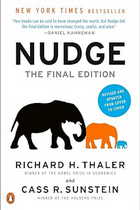
Nudge
The book starts off with a condescending tone, emphasizing that society consists of Humans or Econs, and it is written to help the former’the Humans. The author takes it a step further by calling Humans as the “Homers” of society, portraying them as lacking basic common sense and the ability to reason. This provocative tone may be intentional, and if you can get past it and continue reading, the book does offer a few valuable takeaways. The main point the author tries to bring across is that policies should account for human irrationality rather than just the ideologies of Econs. The author introduces the concept of “Libertarian Paternalism,“ which argues that while people should have the freedom to choose, they also need nudges to help guide them toward better decisions. These nudges include strategies such as placing healthy food prominently in cafeterias, automatically enrolling employees in pension plans, or encouraging more environmentally sustainable practices. The authors highlight how nudges can be introduced in the American healthcare system, politics, and education system. In my opinion, the concept of nudges is not new’it has always existed. For this reason, I feel the book is more relevant to American readers. While the book is informative, it doesn’t present any groundbreaking ideas. It feels like a compilation of borrowed concepts. It is not a bad book and might be interesting for some.
© 2026 Sindhuja Cheema Enzinger. All Rights Reserved.
